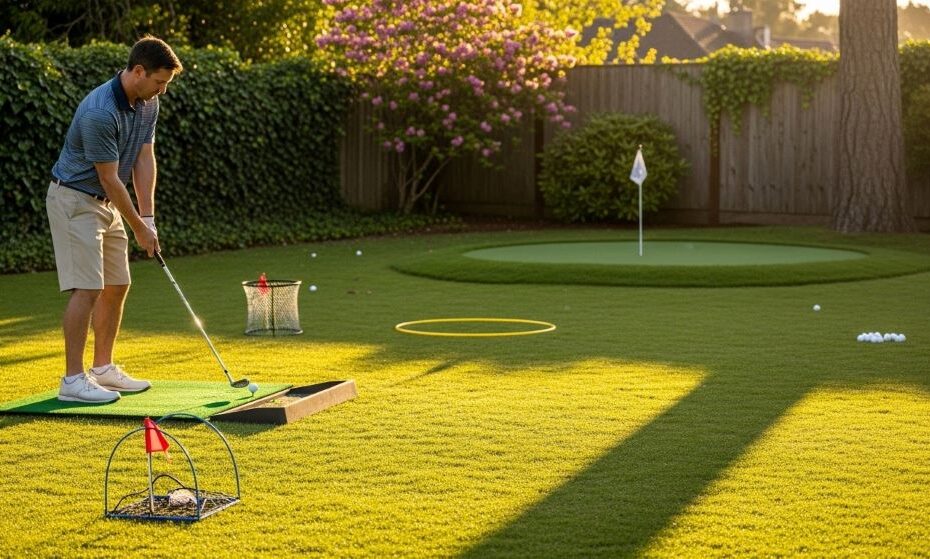
The short game separates good golfers from great ones. While driving distance impresses on the first tee, your ability to chip, pitch, and execute delicate shots around the green determines your actual score. Many golfers struggle with consistency in these crucial areas simply because they don’t practice enough.
Practicing your short game doesn’t require constant trips to the golf course or driving range. A backyard chipping mat brings the practice facility to your home, allowing you to work on these essential skills whenever you have spare time. This convenient solution transforms how you approach short game improvement.
This comprehensive guide will show you how to maximize your practice sessions using chipping mats. You’ll learn proper techniques, effective drills, and strategies that translate directly to lower scores on the course. Whether you’re a beginner looking to build fundamentals or an experienced player fine-tuning your touch, these insights will elevate your performance around the greens.
Understanding the Value of Dedicated Short Game Practice
Most amateur golfers spend the majority of their practice time hitting drivers and long irons. This approach seems logical because those clubs feel more difficult to control. However, statistics reveal that most shots during a round occur within 100 yards of the green.
Professional golfers dedicate significant portions of their practice schedules to the short game. They understand that saving strokes around the green provides more scoring opportunities than gaining a few extra yards off the tee. A well-executed chip can save par or set up an easy putt, while a poor one leads to bogeys or worse.
The repetitive nature of short game practice builds muscle memory and confidence. These shots require feel and touch rather than power, making them perfect for home practice. Additionally, working on your chipping stroke helps develop overall swing fundamentals that benefit your entire game.
Consistency comes from repetition under various conditions. When you can practice at home regularly, you develop a deeper understanding of how different clubs react and how your technique affects ball flight. This knowledge proves invaluable during pressure situations on the course.
Choosing the Right Practice Equipment
Not all practice mats are created equal. The quality and features of your chosen mat significantly impact how effectively you can practice and how well your skills transfer to real grass.
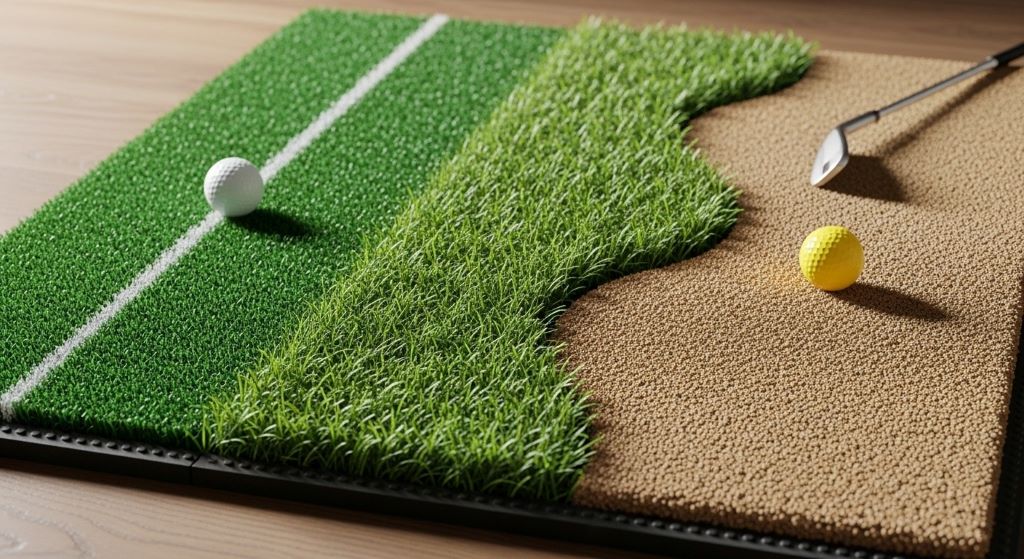
Look for mats with multiple turf surfaces that simulate different lies. Real golf courses present various conditions including tight lies, fluffy grass, and everything in between. A golf short game mat with diverse surfaces lets you practice adapting your technique to different situations.
Target areas and alignment aids help you focus your practice. Mats with built-in targets at various distances encourage you to practice trajectory control and distance management. These features transform casual swinging into purposeful practice with measurable goals.
Durability matters when you’re planning regular practice sessions. Quality mats withstand thousands of swings without showing significant wear. Check reviews focusing on long-term durability rather than just initial impressions. Materials like synthetic turf with proper backing last longer than cheaper alternatives.
Portability becomes important if you want to practice in different locations or store the mat when not in use. Some designs fold or roll up easily, while others are more permanent installations. Consider your available space and storage options when making your selection.
Realistic feedback is perhaps the most critical feature. The mat should allow your club to interact with the surface similarly to how it would with real grass. Mats that are too hard or too soft create muscle memory that doesn’t translate to the course.
Setting Up Your Practice Area
Creating an effective practice space requires more than just placing a mat in your yard. Thoughtful setup maximizes the value of each practice session and keeps you motivated to practice regularly.
Choose a location with adequate space for full swings without restrictions. You need room behind the mat for your backswing and sufficient clearance in front for follow-through. Ideally, you should have at least 15 feet of open space in front of the mat for chips to land safely.
Consider the direction you’ll be hitting relative to your home and neighbors. Safety should always be your primary concern. Hitting toward an open area or against a net prevents errant shots from causing damage or disturbing others.
Lighting affects practice quality, especially for evening sessions. Good lighting helps you see your ball position, club face alignment, and the landing spot of your chips. Natural light works best, but adding outdoor lighting extends your practice opportunities beyond daylight hours.
The ground beneath your mat should be relatively level. Practicing on sloped surfaces creates inconsistent lies and makes it difficult to develop proper technique. If your yard has slopes, find the flatest area available or consider creating a level platform.
Complement your mat with targets at various distances. These can be anything from hula hoops to buckets to specialized chipping nets. Having specific targets transforms practice from mindless repetition into focused skill development with immediate feedback.
Mastering Basic Chipping Technique
Before diving into advanced drills, ensure your fundamental chipping technique is sound. Poor fundamentals practiced repeatedly only reinforce bad habits that hurt your performance on the course.
Start with proper setup and posture. Position the ball slightly back in your stance, typically just right of center for right-handed golfers. Your weight should favor your front foot, with about 60 to 70 percent distribution forward. This forward weight helps ensure downward contact with the ball.
Grip down on the club for better control. Choking down an inch or two increases your feel and makes it easier to control distance. Your grip pressure should be light, allowing your wrists to hinge naturally while maintaining control throughout the swing.
Keep your lower body quiet during the stroke. Excessive leg movement creates inconsistency and makes solid contact more difficult. Your legs should provide a stable base while your upper body and arms execute the shot.
Use your shoulders to control the swing rather than your hands and wrists. Think of your chipping stroke as a smaller version of your full swing, maintaining the triangle formed by your shoulders and arms. This approach produces more consistent contact and predictable results.
Accelerate through impact rather than decelerating. Many golfers make the mistake of swinging back too far and then slowing down through the ball. This creates inconsistent contact and unpredictable distances. Instead, make a controlled backswing and accelerate smoothly through the ball.
Developing Distance Control
Controlling how far the ball travels is often more important than perfect contact. A chip that goes the right distance but isn’t struck perfectly usually produces a better outcome than a pure strike that flies past the hole.
Practice with different clubs to understand how each performs. Your sand wedge, pitching wedge, and even your 9-iron can all be effective chipping clubs. Each produces different trajectories and roll patterns. Spending time with various clubs expands your shot options on the course.
The clock drill helps develop precise distance control. Imagine your backswing and follow-through as positions on a clock face. Practice taking the club back to 8 o’clock and through to 4 o’clock, then 9 to 3, and so on. This creates consistent reference points for different distances.
Count your steps from the mat to various targets. Knowing that a specific backswing length combined with a particular club produces a 20-step chip gives you a reliable system for distance control. Over time, this becomes intuitive rather than mechanical.
Pay attention to how different swing speeds affect distance. Sometimes a shorter backswing with slightly faster acceleration produces the same distance as a longer backswing with slower tempo. Experimenting with these variables helps you develop feel and adaptability.
Landing spot awareness is crucial for controlling overall distance. The ball’s behavior after landing depends on the trajectory and spin you create. Practice visualizing and executing shots that land on specific spots, observing how they react and adjusting accordingly.
Creating Effective Practice Routines
Random practice without structure produces limited improvement. Organized routines with specific goals accelerate skill development and make your practice time more productive.
Start each session with a warm-up routine. Hit a few easy chips to get your body and mind engaged. This prevents injury and helps you establish rhythm before moving into more demanding drills. Five to ten minutes of relaxed chipping prepares you for focused practice.
Progressive distance drills build consistency across various ranges. Set up targets at 10, 20, 30, and 40 feet. Hit five chips to each target, working through the distances in order. This drill develops your ability to adjust for different yardages, which is essential on the course.
The ladder drill challenges your precision and control. Place targets at incrementing distances and try to land one ball at each target in sequence without missing. If you miss, start over. This drill combines distance control with pressure, simulating on-course situations.
Alternating club practice prevents you from getting too comfortable with a single option. Hit three chips with your sand wedge, then three with your pitching wedge, then three with a 9-iron. This forces you to adjust your setup and swing for different clubs, building versatility.
Finish each session with a fun challenge or game. This keeps practice enjoyable and ends on a positive note. Try to make five chips in a row into a target, or compete against a previous score. Making practice enjoyable increases the likelihood you’ll stick with it long-term.
Simulating On-Course Pressure
Practice without pressure doesn’t fully prepare you for real rounds. Learning to perform under pressure separates range players from course performers. Therefore, incorporating pressure situations into your home practice is essential.
Create consequences for missed shots. If you miss a target, you have to do five push-ups or start your drill over. These small stakes make each shot matter more, training your mind to focus when it counts.
Use a scoring system to track performance. Assign point values to different targets based on difficulty. Keep track of your scores over time to measure improvement. Seeing tangible progress maintains motivation and identifies areas needing work.
Practice in varying conditions when possible. Wind, light rain, or fading light make practice more challenging but also more realistic. Learning to adapt to less-than-perfect conditions builds confidence and capability for actual rounds.
Time yourself during certain drills. Give yourself 60 seconds to hit as many successful chips as possible to a target. This creates urgency and tests your ability to execute quickly without sacrificing quality.
Visualize actual holes you play regularly. Instead of just hitting to a generic target, imagine you’re facing that tricky chip on your home course’s 7th hole. This mental connection helps your practice transfer more directly to real situations.
Troubleshooting Common Chipping Problems
Even with dedicated practice, certain issues may persist. Understanding common problems and their solutions helps you diagnose and correct technique flaws quickly.
Chunking or hitting behind the ball typically results from weight distribution errors. Make sure your weight favors your front foot at address and stays there throughout the swing. Additionally, check that you’re not trying to help the ball up by falling back on your rear foot.
Blading or hitting the ball thin often comes from trying to scoop it into the air. Trust your club’s loft to get the ball airborne. Focus on striking down and through the ball rather than trying to lift it. Your hands should be slightly ahead of the ball at impact.
Inconsistent contact frequently results from excessive wrist action. If your distances vary wildly with similar swings, you’re probably flipping your wrists through impact. Focus on maintaining the triangle formed by your arms and shoulders, letting your body rotation control the club.
Direction control problems may indicate alignment issues. Check that your body, especially your hips and shoulders, are aligned with your target. Many golfers aim their feet correctly but have their shoulders pointing elsewhere, causing inconsistent direction.
Lack of confidence often stems from unclear pre-shot routine. Develop a consistent routine that you repeat before every chip, both in practice and on the course. This mental preparation creates familiarity and reduces anxiety over shots.
Tracking Progress and Setting Goals
Measuring improvement keeps you motivated and helps identify which areas need additional work. Without tracking, it’s difficult to know if your practice is actually translating to better performance.
Keep a practice journal documenting your sessions. Note which drills you performed, how many successful attempts you made, and any insights about your technique. Over time, this record reveals patterns and progress that might not be obvious day to day.
Test yourself monthly with standardized challenges. Pick three or four specific targets and record how many attempts it takes to land five balls on each target. Performing this same test monthly provides concrete data about your improvement.
Record video of your practice sessions periodically. Watching yourself helps identify technique issues you can’t feel during the swing. Compare videos over time to see how your fundamentals evolve with practice.
Set specific, measurable goals for your short game. Rather than vague aspirations like “get better at chipping,” aim for concrete objectives like “land 8 out of 10 chips within three feet of a target 20 feet away.” Specific goals give you clear targets to work toward.
Translate practice performance to on-course expectations. If you can consistently execute certain shots on your mat, expect to handle similar situations on the course. This confidence connection helps reduce anxiety during actual rounds.
Integrating Mat Practice with Course Play
The ultimate goal of home practice is better performance during actual rounds. Making sure your mat work translates to the course requires intentional integration.
Before playing a round, spend 15 minutes on your mat practicing the types of shots you commonly face on your course. This pre-round preparation gets your touch dialed in and builds confidence for the challenges ahead.
After rounds, recreate shots you struggled with on your mat. If you chunked a chip on the 12th hole, practice that specific type of shot at home. This targeted practice addresses weaknesses immediately while the memory is fresh.
Compare your on-course results with your practice performance. If you’re executing well at home but struggling on the course, the issue is likely mental rather than technical. Conversely, if you struggle in both places, continue working on fundamentals.
Use your mat to experiment with shots you’re hesitant to try on the course. Testing different clubs, trajectories, and techniques in your yard removes the pressure of affecting your score. Once you’ve developed confidence at home, introduce these shots into your course play gradually.
Remember that real grass behaves differently than synthetic surfaces. Your mat provides excellent practice for fundamentals and repetition, but occasionally verify your technique on actual grass to ensure proper transfer of skills.
Conclusion
Improving your short game dramatically lowers your scores and increases your enjoyment of golf. A backyard chipping mat provides the perfect platform for developing the consistency and confidence needed around the greens. By practicing regularly at home, you gain repetitions that would be impossible to achieve through occasional range visits alone.
The key to effective improvement lies in purposeful practice rather than mindless repetition. Use structured drills, set specific goals, and create pressure situations that simulate actual course conditions. Focus on fundamental technique while also developing the distance control and touch that separate good chippers from great ones.
A golf short game mat transforms idle time into productive practice sessions. Whether you have five minutes or an hour, you can work on shots that directly impact your scores. This convenience removes barriers to consistent practice and accelerates your skill development.
Remember that quality matters more than quantity. Thirty minutes of focused, deliberate practice beats hours of unfocused swinging. Stay engaged mentally during your sessions, analyze your results, and continuously refine your approach based on what you learn.
Commit to regular practice, track your progress, and trust the process. The investment of time and effort in your short game pays dividends every time you step onto the course. With dedication and smart practice using your chipping mat, you’ll soon see lower scores and greater confidence in your ability to get up and down from anywhere around the green.
Frequently Asked Questions
How often should I practice on my chipping mat to see improvement?
Practicing three to four times per week for 20 to 30 minutes each session typically produces noticeable improvement within a month. However, shorter daily sessions of 10 to 15 minutes can be equally effective because they create consistent repetition. The key is regularity rather than session length. Even five minutes of focused practice daily builds muscle memory better than sporadic longer sessions. Most golfers see significant improvement in their on-course short game within six to eight weeks of consistent home practice.
Can practicing on a mat damage my wedges?
Quality mats designed specifically for golf practice should not damage your clubs with normal use. However, cheaper mats with hard surfaces or inadequate padding can accelerate wear on your club’s leading edge and sole. Look for mats with multiple turf heights and cushioning beneath the hitting surface. Additionally, avoid excessive force during practice. The goal is to develop touch and feel, not to pound balls aggressively. Rotating between multiple wedges during practice also distributes wear evenly.
Will practice on artificial turf transfer to real grass conditions?
Yes, if you focus on proper fundamentals and technique rather than relying on how the mat reacts. Quality practice mats help you develop solid contact, consistent swing path, and distance control, all of which transfer directly to grass. However, recognize that real grass provides different feedback and interaction. Periodically practice on actual grass to verify your technique and make small adjustments. The combination of regular mat practice for repetition and occasional grass practice for verification produces the best results.
What’s the ideal distance to place targets from my chipping mat?
Start with targets at 10, 20, and 30 feet for building basic skills. As you improve, add targets out to 50 or 60 feet to expand your range. Most recreational golfers face chips ranging from 10 to 40 feet most frequently, so focus your practice on this range. However, don’t neglect longer chips and pitches, as versatility prepares you for any situation. Having targets at multiple distances allows you to practice the variety you’ll encounter on the course.
How do I know if my chipping mat is good quality?
Quality indicators include multiple turf heights simulating different lies, durable construction that withstands repeated use, realistic interaction allowing your club to take divots or slide beneath the ball naturally, and portable design for easy setup and storage. Read long-term user reviews focusing on durability after months of use rather than initial impressions. Test the mat by hitting chips with various clubs and observing whether the feedback feels realistic. A good mat should allow clean contact without excessive resistance or unrealistic bouncing.
Related Topics:
How to Find an Affordable Junior Golf Club Set That Offers Real Value
Fabien Diomande Net Worth: A Deep Dive Into His Wealth and Success