Key Takeaways
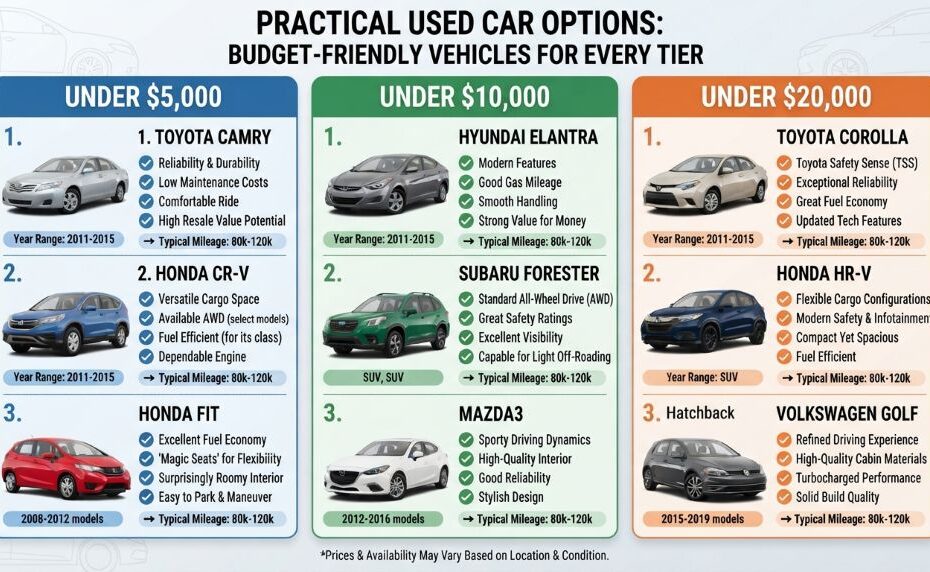
- The best used cars in 2026 balance reliability, price, and low running costs.
- Compact sedans like the Corolla and Civic remain top value choices.
- SUVs and crossovers offer practicality without sacrificing dependability.
- Certified pre-owned programs reduce risk for budget-conscious buyers.
- Checking maintenance history matters more than chasing the lowest price.
Buying a used car in 2026 means navigating a market shaped by high new-car prices. Many buyers now see used vehicles as the smarter financial move. According to Kelley Blue Book, cars priced under $10,000 retain roughly 70 percent of their value after three years. That statistic alone explains why the used market stays competitive.
This guide highlights the best used cars for 2026, based on reliability data, affordability, and daily practicality. I bought a 2018 Corolla two years ago after months of research, and it has yet to need anything beyond routine service. That experience shaped much of the advice below.
Why the Used Car Market Looks Different in 2026
New car prices haven’t slowed down, pushing more buyers toward pre-owned options. Consumer Reports notes that used-car shoppers increasingly refuse to sacrifice safety or reliability for a lower price tag. That shift has forced sellers to compete harder on both fronts.
Technology has also changed what counts as a “budget” vehicle. Many used cars now include safety features once reserved for luxury trims. Automatic emergency braking and lane-keeping assist appear in mainstream models from just a few years ago. Consequently, buyers can get modern safety tech without paying new-car prices.
Interest rates remain another factor shaping decisions. Financing a used vehicle typically costs less overall than financing a new one. However, loan terms vary widely, so shopping multiple lenders still matters. A lower monthly payment sometimes hides a longer, costlier loan term.
Consumer Reports has expanded its used-car coverage specifically because demand keeps rising. Their testing methodology now emphasizes value alongside raw reliability scores. Interestingly, some models that scored average when new have become bargains as used cars. The Buick Envision and Chevrolet Cruze fall into this category, offering dependable performance at reduced resale prices. That logic rewards buyers willing to look past badge reputation alone.
Best Used Sedans for Reliability and Value
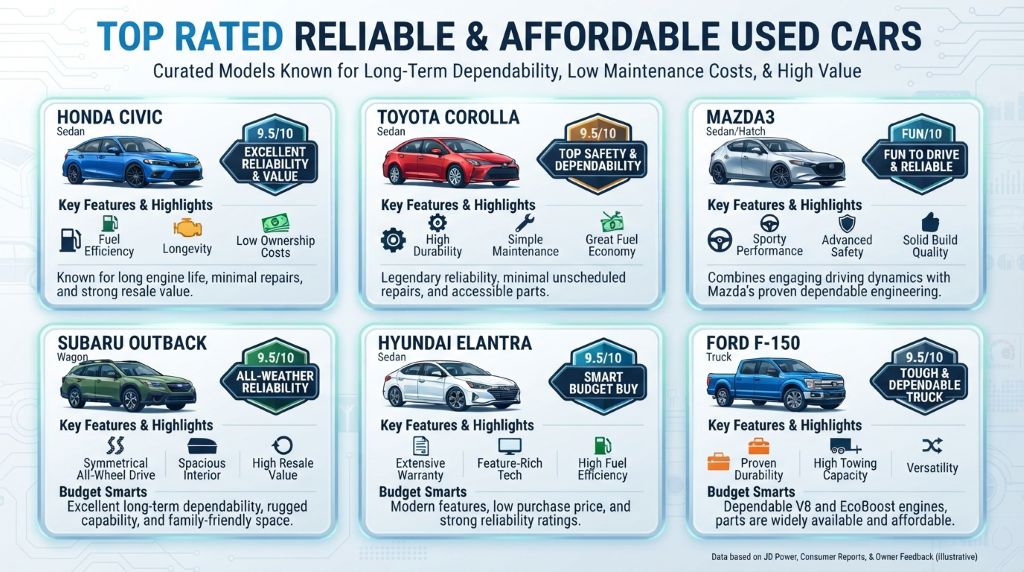
Sedans remain some of the best used cars for buyers who prioritize fuel economy and low upkeep costs. Three models consistently stand out across independent testing.
- Toyota Corolla (2017–2019): Known for dependable engines and low repair frequency.
- Honda Civic (2018–2020): Offers a smooth 2.0-liter engine and strong resale value.
- Mazda6 (2016 model year): Delivers 32 mpg overall with a refined, comfortable interior.
The Corolla’s reputation isn’t just marketing. Toyota’s conservative engineering philosophy favors proven components over experimental technology. That approach reduces the chance of unexpected failures, which matters most for buyers avoiding surprise repair bills.
The Civic earns its spot through a mix of efficiency and driving feel. Its infotainment system, introduced in the 2019 refresh, added modern convenience without sacrificing reliability. Additionally, parts availability remains excellent, keeping repair costs manageable nationwide.
The Mazda6 often gets overlooked next to Toyota and Honda. However, Consumer Reports testing found its four-cylinder powertrain smooth and its interior nicely finished. Back-seat space runs tighter than rivals, so families cross-shopping should test rear legroom first. For solo drivers or couples, that tradeoff rarely matters.
Each of these sedans balances affordability with proven mechanical durability. Buyers focused purely on cost per mile driven should start their search here.
Best Used SUVs and Crossovers for Practicality
Families and drivers needing cargo space often gravitate toward SUVs. Fortunately, several models combine practicality with strong reliability records.
- Subaru Outback: All-wheel drive standard, useful for varied weather conditions.
- Honda CR-V: Consistently ranks among the most dependable compact SUVs.
- Toyota RAV4: Offers strong resale value and low long-term ownership costs.
The Outback’s standard all-wheel drive makes it a favorite in regions with unpredictable weather. Unlike many competitors charging extra for AWD, Subaru includes it across the lineup. That inclusion adds real value, especially for buyers in northern climates.
The CR-V earns its reputation through consistency rather than flash. Honda’s engineering team prioritizes refinement over aggressive redesigns, which keeps failure rates low. Owners frequently report minimal issues even past 150,000 miles with regular maintenance.
The RAV4 benefits from Toyota’s broader reliability halo. Its resale value stays notably strong, which cuts into savings if buying used but helps significantly when reselling later. Therefore, total cost of ownership often balances out favorably compared to less popular SUVs.
All three models share one advantage: widespread availability. Because manufacturers sell them in high volumes, parts and independent mechanics familiar with these platforms are easy to find. That accessibility reduces repair wait times and labor costs substantially.
How to Verify Reliability Before Buying
Reputation alone shouldn’t drive a purchase decision. Verifying a specific vehicle’s condition protects against inheriting someone else’s neglected maintenance.
Start with a complete vehicle history report. Services like Carfax reveal accident history, title issues, and past ownership patterns. A clean report doesn’t guarantee perfection, but it eliminates obvious red flags quickly.
Request maintenance records directly from the seller whenever possible. A documented service history shows whether oil changes, brake service, and fluid flushes happened on schedule. Missing records don’t automatically mean trouble, but they raise the risk level.
Independent pre-purchase inspections remain worth the cost every time. A trusted mechanic can spot issues a casual test drive misses entirely. Spending $150 on an inspection often saves thousands in avoided repairs.
Certified pre-owned programs add another layer of protection for nervous buyers. These programs typically include extended warranties and multi-point inspections before resale. While certified vehicles cost more upfront, the added assurance often justifies the premium for first-time used buyers.
Final Thoughts
Finding the best used cars in 2026 comes down to matching reliability data with real-world needs. Sedans like the Corolla and Civic reward buyers chasing low running costs, while SUVs like the CR-V and Outback serve families needing extra space and capability. Still, even reliable models can develop issues with age and mileage, so understanding the common problems with used cars can help you spot potential repair costs before buying.
My own Corolla purchase proved that research pays off. Two years of reliable ownership have reinforced everything the data suggested beforehand. Trusting proven track records over flashy features remains the smartest strategy for used car shopping.
Share this guide with someone hunting for their next used car, or drop a comment about your own reliable pick. Real experiences help other buyers shop smarter.
Frequently Asked Questions
What is the most reliable used car under $20,000?
The Toyota Corolla consistently ranks among the most reliable and affordable used sedans available.
Should I buy a used SUV or sedan for reliability?
Both categories offer reliable options; choose based on space needs rather than reliability alone.
Is a vehicle history report enough before buying used?
No, always pair it with an independent mechanic inspection for full confidence.
Do certified pre-owned cars really cost more?
Yes, typically several hundred to a few thousand dollars more, but they include added warranty protection.
How much value do used cars retain after a few years?
Cars under $10,000 retain roughly 70 percent of their value after three years, according to Kelley Blue Book.