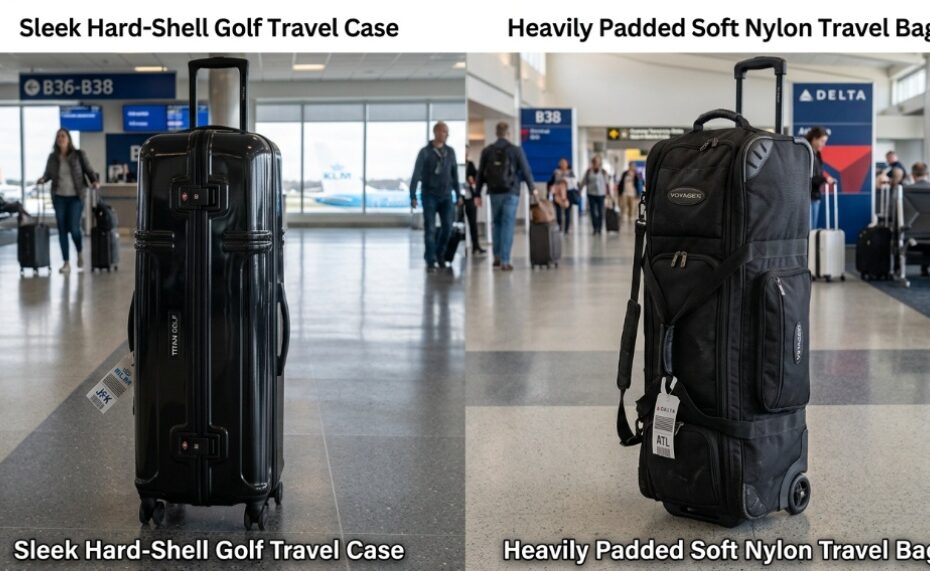
You’ve booked the flight, mapped out the courses, and you’re already thinking about that first tee shot. Then comes the moment every golfer dreads: handing your clubs to the airline and hoping they survive the trip. Choosing between a soft or hard travel case is one of the most consequential gear decisions a traveling golfer makes, and if you’re searching for the best golf travel bag Georgia golfers actually rely on, you’ve probably noticed the debate rarely produces a simple answer. The truth is that neither design wins outright — each protects your set differently, and the right choice depends on how you travel, what’s in your bag, and how much weight you’re willing to carry.
Quick Answer
Hard cases offer superior protection against impact, crushing, and stacking, making them the safer choice for frequent flyers and expensive equipment. Soft cases are lighter, easier to store, and more flexible when packing, but they rely on internal bracing and careful packing to prevent damage. For most casual travelers, a well-padded soft case with a stiff arm and proper club protection is sufficient. For maximum security — especially on multi-leg or international flights — a hard case is the stronger option.
Key Takeaways
- Hard cases win on raw protection and rigidity; soft cases win on weight, portability, and storage.
- Soft cases only protect well when they have a stiff arm, padded club headcovers, and a snug fit.
- Airline handling involves stacking weight on top of bags, which is where soft cases typically fail.
- Rental cars, hotel rooms, and small trunks favor soft cases; peace of mind on rough itineraries favors hard cases.
- Neither type is damage-proof — how you pack matters as much as which case you buy.
How Each Case Type Actually Protects Your Clubs
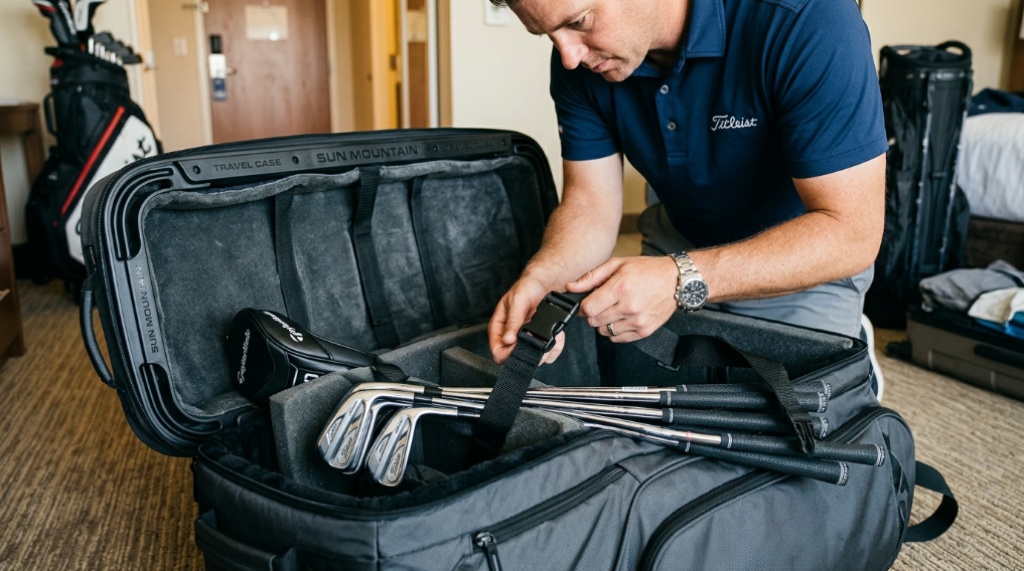
Understanding the mechanics of protection helps you stop guessing. The two designs fail in completely different ways, which is why the “which is better” question has no universal answer.
Hard Cases: Protection Through Rigidity
A hard case resists force by refusing to deform. When baggage handlers stack suitcases on top of it or a conveyor belt drops it, the shell absorbs and deflects the impact rather than passing it to your clubs. That rigidity is the entire point. Most hard cases also have a molded interior with foam or dividers that keep clubs from shifting, and some lock closed, which adds a layer of security against tampering.
The trade-off is weight and bulk. A hard case can be noticeably heavier than a soft one before you’ve packed a single club, and that extra weight counts against your airline baggage allowance. Storage is another friction point — hard cases take up serious space in a garage, closet, or rental car trunk, and they rarely fold down.
Soft Cases: Protection Through Padding and Flex
A soft case protects by cushioning and absorbing impact rather than resisting it. The padding, combined with internal bracing like a stiff arm or spine rod, creates a barrier between your clubs and the outside world. Flexible sidewalls also mean the case can accommodate slightly oversized bags and can be squeezed into tight spaces.
The weakness is compression. Soft cases have little defense against weight stacked directly on top, and if a clubhead isn’t protected, it can transfer force into the shaft, which is why snapped shafts are the classic soft-case failure. This is also why soft cases are much less effective without supplemental protection inside.
Soft vs. Hard Golf Travel Cases: Head-to-Head Comparison
| Factor | Soft Case | Hard Case |
|---|---|---|
| Impact protection | Good with padding and bracing | Excellent |
| Resistance to crushing | Weak unless braced | Very strong |
| Weight (empty) | Lighter | Heavier |
| Storage and folding | Folds flat or compact | Takes fixed space |
| Fits in rental car trunk | Usually yes | Sometimes tight |
| Lockability | Limited (zipper locks possible) | Common |
| Airline check handling | Adequate with prep | Most dependable |
| Best for | Occasional travelers, tight storage | Frequent flyers, premium sets |
There are no official test scores behind these ratings — they reflect how each design behaves in normal airline and road-trip conditions. Use the table as a decision aid, not a spec sheet.
When a Soft Case Is the Smarter Choice
Soft cases earn their place in several realistic scenarios. If you fly a few times a year, drive to most of your golf destinations, and need something that stows easily, a soft case with the right internal setup will protect your clubs just fine.
They’re also the better pick when weight matters. If you’re already near the top of your airline’s baggage limit, a lighter soft case can make the difference between checking your bag normally and paying an overweight fee. And because soft cases conform to odd shapes, they can be easier to squeeze into a packed SUV or a hotel luggage rack.
What soft cases demand in return is discipline. A soft case without a stiff arm and proper headcovers is essentially a padded duffel bag for clubs — and it will behave like one, Once your clubs are securely packed for your trip, make sure you are prepared for local weather conditions by reading our guide on how to pick golf balls for texas golfers before heading out to play.
When a Hard Case Is Worth the Bulk
Hard cases are the safer bet for anyone who flies frequently, takes multi-leg itineraries, travels internationally, or is carrying a set they can’t easily replace. The more transfers and the more handling your bag goes through, the more the odds stack against a soft case’s weaker compression resistance.
They also make sense if your set includes fitted clubs, premium shafts, or anything you’d genuinely struggle to replace. If your clubs are essentially irreplaceable in your mind, the extra weight and storage hassle of a hard case is a small price to pay.
The main caveat: hard cases can be awkward to transport on the ground. If your trip involves a lot of walking between transport and the course, that bulk becomes a real inconvenience.
Packing Mistakes That Ruin Protection in Either Case
Most travel damage isn’t caused by the case type — it’s caused by what’s happening inside it. The following mistakes undermine even a good case:
- Skipping a stiff arm or spine rod in a soft case. Without it, the top of the bag can be compressed and clubs can snap.
- Leaving clubheads unprotected. Iron heads should be covered or wrapped so they don’t grind against shafts during transit.
- Packing clubs loosely. A snug bag reduces movement; a loose one invites impact damage.
- Overpacking the top of the bag. Extra items near the clubheads increase the chance of pressure damage.
- Assuming a case is waterproof. Neither type is fully waterproof, and luggage often sits on wet tarmac. Use a rain cover or dry bag inside.
If you want maximum protection from a soft case, combine a stiff arm, padded headcovers, a snug internal fit, and placing soft items like towels or rain gear around the top of the clubheads for extra cushioning.
Practical Decision Guide: Which Should You Buy?
Cut through the marketing by answering a few honest questions about your own travel:
- How often do you fly with clubs? Multiple flights per year pushes you toward hard. Once or twice pushes you toward soft.
- How valuable is your set? If replacement would hurt financially, hard is the safer bet.
- How much storage do you have? If space is limited at home, soft is far more practical.
- Do you mind the extra weight? Hard cases can push you into overweight baggage fees.
- How rough is your itinerary? Multi-leg and international trips favor hard cases.
If you answer three or more in favor of hard, buy hard. Otherwise, a properly equipped soft case will serve you well — and save you weight and space in the process.
Frequently Asked Questions
Are hard golf travel cases actually safer than soft ones?
Yes, generally. Hard cases resist crushing and impact better, which makes them more reliable when baggage is stacked or handled roughly. Soft cases can protect well too, but only when packed with a stiff arm and proper club protection.
Do airlines require a hard case for golf clubs?
No. Most airlines accept both soft and hard golf travel cases as checked baggage. Some require a signed damage waiver for soft cases, so it’s worth checking your specific airline’s policy before flying.
Can I fit a golf travel case in a rental car trunk?
A soft case usually fits without trouble. A hard case may not fit in smaller sedan trunks, so if you’re renting a compact car, measure or choose soft — or plan to lay the case across the back seat.
How should I pack a soft golf travel case to avoid damage?
Use a stiff arm or spine rod, cover all clubheads, pack the bag snugly so clubs can’t shift, and surround the top of the bag with soft items like towels or rain gear. Then secure the outside straps tightly.
Is a travel case covered by airline liability if my clubs are damaged?
Airlines are liable for checked baggage under regulations, but coverage is limited and varies by carrier and trip type. For expensive sets, consider separate travel insurance that specifically covers golf equipment.
Do hard cases cost more than soft cases?
Hard cases typically cost more than soft cases at comparable quality levels. However, prices vary widely by brand and features, so compare specific models rather than assuming the category price.
Conclusion
There’s no single winner in the soft vs. hard golf travel case debate — only the right answer for your trip. Hard cases give you the best protection against the rough reality of airline handling, while soft cases offer lighter weight, easier storage, and enough protection when you pack them properly. Match the case to how often you fly, how valuable your set is, and how much space and weight you can live with. Do that, and your clubs will arrive ready to play.