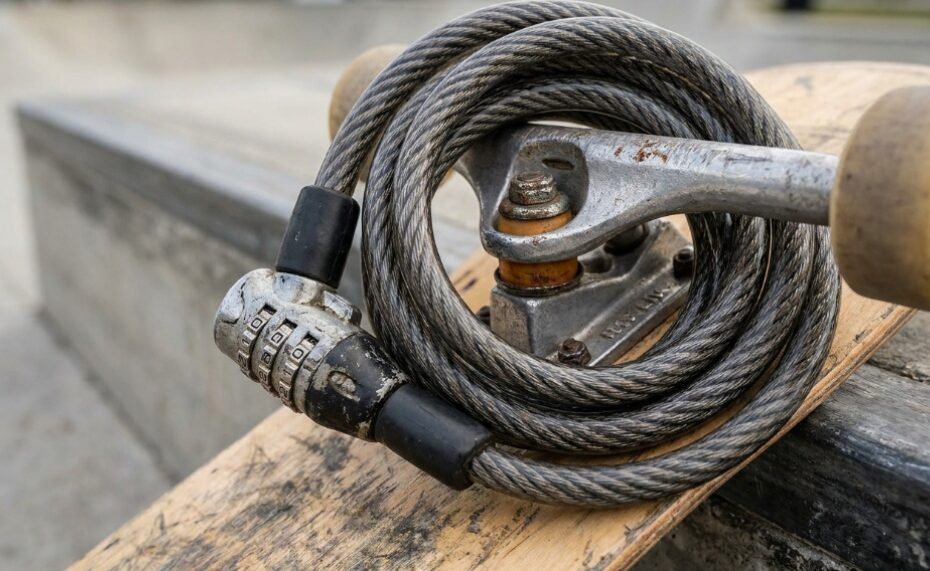
Leaving a board unattended in California is a calculated risk. A quick stop at a Santa Monica coffee shop or a study session at a campus library is all it takes for an unsecured deck to disappear. The solution isn’t a heavier padlock; it’s a locking system designed specifically for the shape of a skateboard. This guide breaks down how to choose a heavy duty skateboard cable lock that actually fits your board, your route, and your budget, without overspending on security features you don’t need.
Key Takeaways
- Standard U-locks often fail on skateboards because the deck’s width and truck geometry leave too much slack; flexible cable locks are usually the better fit.
- Security ratings on cable locks describe resistance time, not theft prevention. A determined thief with bolt cutters will eventually win against almost any cable.
- California’s climate matters. Salt air near the coast accelerates corrosion on cheap steel, so look for coated or stainless components if you ride near the beach.
- Locking technique matters as much as the lock itself. Loop through a truck baseplate or a wheel, not just the deck, and anchor to something immovable.
- Carrying convenience determines whether you actually use the lock. A lock that stays in a backpack is worthless.
What Makes a Skateboard Lock Different From a Bike Lock
The core problem is shape, not just security. Skateboards have no closed frame, so a rigid U-lock has nothing structural to grip. You can wrap a U-lock around the deck, but the shackle usually won’t close tightly enough to prevent someone from sliding the board out. That gap is where most thefts happen.
Cable locks solve this by being flexible enough to thread through a truck baseplate, a wheel, or the gap between deck and truck. A heavy duty skateboard cable lock typically uses a braided steel cable with a lockable loop or a combination mechanism. The flexibility lets you create a tight wrap that’s harder to slip out of than a rigid shackle.
The trade-off is cutting resistance. Cable locks are generally easier to cut than a quality U-lock of similar weight because the individual strands can be severed one at a time. For a skateboard, that’s often an acceptable trade-off because the alternative (a U-lock that doesn’t fit) provides zero security.
How to Judge Cable Thickness and Lock Quality
Cable diameter is the primary spec to check, but it’s not the only one. Thicker isn’t automatically better if the locking mechanism is weak.
As a general guideline, cables under about 8mm are best treated as deterrents for very short stops in low-risk areas. Cables in the 10–12mm range offer more resistance to hand tools and are a reasonable middle ground for daily use. Anything thicker gets heavy and stiff, which defeats the portability advantage that makes cable locks useful in the first place.
The lock head matters just as much as the cable. Look for a mechanism that resists picking and drilling, and check whether the lock body is shielded. A thick cable attached to a flimsy lock body is a weak link waiting to be exploited.
Coating is another practical factor. Vinyl or rubber sleeves protect the board’s finish from scratches and slow down moisture reaching the steel core. In coastal California cities, that coating makes a measurable difference in how long the lock lasts before rust becomes a problem.
Combination vs. Keyed Locks for Skateboards
Both work. The choice comes down to how you ride and what you’re willing to manage.
Combination locks eliminate the key problem. You can’t lose a key you don’t carry, and you can share the code with a friend who needs to grab your board. The downside is that resettable combinations can be forgotten, and cheaper combination mechanisms can be vulnerable to decoding techniques.
Keyed locks generally offer better pick and drill resistance at the same price point, and they’re faster to open in the dark. The obvious risk is losing the key. If you go keyed, carry a spare somewhere separate from your main keys.
A practical middle ground for many riders is a keyed lock with a combination backup or a combination lock with a well-reviewed mechanism from a brand that publishes its security ratings. Avoid no-name locks with unverifiable claims, before making your final security purchase, make sure to check out this beginner’s guide: buying a skateboard for kids under 6.
Where to Lock Your Board in California
Where you lock matters more than what you lock with. The best lock fails against a bad anchor point.
Look for:
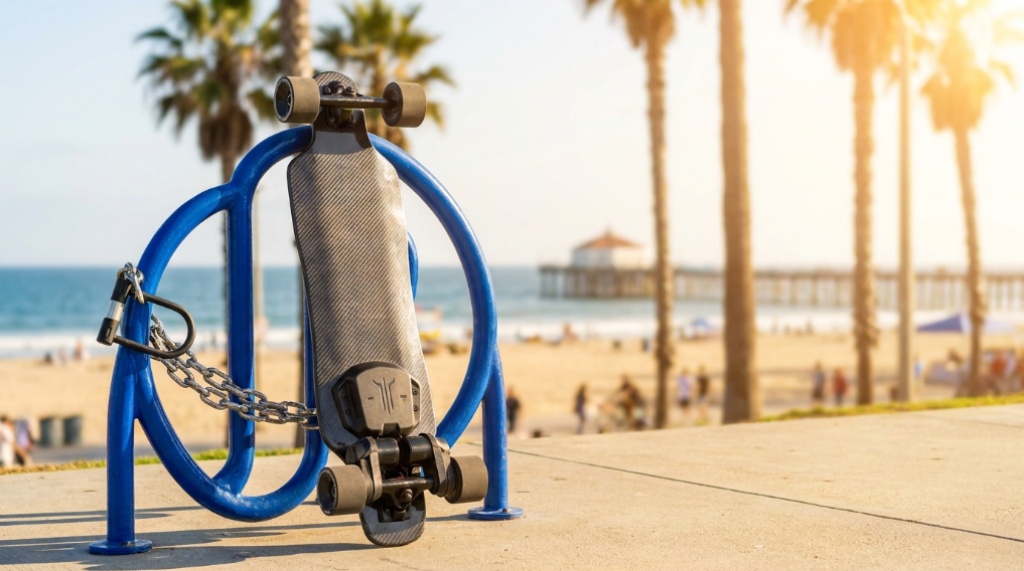
- Bike racks bolted to concrete. These are the standard and usually the most secure option.
- Street sign posts that are firmly planted and not removable. Check that the base isn’t loose.
- Permanent railing that isn’t thin enough to cut or lift over.
Avoid:
- Anything you can lift the lock over, like a parking meter head or a short bollard.
- Thin poles or tree branches that can be cut or broken.
- Anchors in isolated areas where a thief has time and privacy.
In dense areas like San Francisco, Los Angeles, or San Diego, bike racks near busy entrances are usually safer than quiet side streets, simply because more eyes are around. In beach towns, avoid leaving a board locked overnight near the sand; salt air and moisture will degrade the lock and the board’s hardware.
For a broader look at how lock choices vary by region and riding style, this guide to the heavy duty skateboard cable lock options covers California-specific considerations in more detail.
Common Mistakes That Get Boards Stolen
Most skateboard thefts aren’t sophisticated. They exploit simple errors.
Locking only the deck. A cable looped around the deck alone can often be slid off the end, especially on narrow boards. Thread through a truck baseplate or a wheel instead.
Leaving slack. A loose cable gives a thief room to maneuver tools or slip the lock free. Keep the wrap tight.
Using a cheap lock for a long stop. A lightweight cable is fine for a two-minute stop inside a visible location. It is not fine for a two-hour movie.
Ignoring the anchor. Locking to a removable pole or a loose rack post is almost as bad as not locking at all.
Assuming any lock is theft-proof. No consumer lock is. The goal is to make your board a harder target than the next one.
Portability and Carrying Options
A lock you don’t carry is a lock you won’t use. This is where cable locks beat almost every alternative.
Most quality cable locks come with a mounting bracket, but brackets can rattle or fail. Many riders simply coil the lock and stuff it in a backpack or clip it to a belt loop. Coiled cables with a built-in loop are easier to manage than straight cables, which tend to tangle.
If you commute daily, consider a lock that weighs under about a pound and a half. Heavier locks offer more security but get left at home. For occasional use, a heavier lock stored in a bag is a reasonable trade.
Frequently Asked Questions
Is a cable lock strong enough for a skateboard?
For short stops in visible, low-risk areas, a quality cable lock is usually sufficient. For longer stops or high-theft areas, no cable lock is truly secure; it’s a deterrent. Combine a good cable with a smart anchor point and keep stops short.
Can I use a bike U-lock on a skateboard?
You can, but it usually doesn’t fit well. The shackle is too rigid to wrap tightly around a deck or truck, leaving gaps that let the board slide out. Cable locks are generally the better fit for skateboards.
What cable thickness should I look for?
Around 8mm is a minimum for any real deterrent. Cables in the 10–12mm range offer better resistance for daily use. Thicker cables add weight and stiffness, which can make you less likely to carry the lock.
Do I need a different lock for coastal California?
Not a different type, but look for coated cables and lock bodies with corrosion-resistant components. Salt air and moisture near the coast will rust cheap steel quickly, shortening the lock’s useful life.
How long can I safely leave a board locked up?
There’s no guaranteed safe duration. As a rule, the longer the stop and the less visible the location, the higher the risk. Keep locked stops short and use the most secure anchor available.
Conclusion
Choosing the right skateboard lock in California comes down to fit, not just strength. A flexible, well-made cable lock that threads tightly through a truck or wheel will protect your board better than a heavier lock that doesn’t fit properly. Prioritize coated cable in the 10–12mm range, a reputable locking mechanism, and an anchor point that can’t be lifted or cut. Then carry it every time. Consistency matters more than specs.